Job Description
Marketing StatementRide BART to a satisfying career that lets you both: 1) make a difference to Bay Area residents, and 2) enjoy excellent pay, benefits, and employment stability. BART is looking for people who like to be challenged, work in a fast-paced environment, and have a passion for connecting riders to work, school and other places they need to go. BART offers a competitive salary, comprehensive health benefits, paid time off, and the CalPERS retirement program.
Job Summary
Pay Rate
Non-Represented Salary Grade 036
Step 1: $40.16/hour (Minimum) - Step 6: $47.52/hour (Maximum)
Note: The starting negotiable rate of pay will be commensurate with education and experience.
Reports To
Workforce Development Supervisor
Days Off
Saturday/Sunday
Who May Apply
All current BART employees and Future BART employees
Current Assignment
BART is seeking a collaborative, innovative, and customer-focused Human Resources Specialist to join the Workforce Development team.
The Human Resources Specialist will lead and coordinate workforce development programs, including internship, apprenticeship, and early career initiatives that create pathways into public service careers. This position collaborates with hiring managers, mentors, educational institutions, community organizations, and internal stakeholders to design, implement, and continuously improve programs that enhance the candidate and employee experience.
The most qualified candidates for this position will have highly developed competencies in the following areas, which will be reinforced with related work experience and will be clearly articulated during the selection process:
- Customer Service & Relationship Building: Ability to provide responsive, professional service while establishing positive working relationships with employees, candidates, hiring managers, educational partners, and members of the public.
- Organization & Attention to Detail: Strong organizational skills with the ability to manage multiple assignments, maintain accurate records, prioritize competing deadlines, and follow established processes.
- Communication Skills: Excellent written and verbal communication skills, including the ability to communicate clearly, prepare professional correspondence, deliver presentations, and interact effectively with individuals from diverse backgrounds.
- Problem Solving & Adaptability: Ability to identify issues, exercise sound judgment, adapt to changing priorities, and contribute to solutions in a collaborative, fast-paced work environment.
- Planning & Project Coordination: Ability to effectively organize and prioritize multiple projects, coordinate competing deadlines, and produce high-quality work in a fast-paced environment.
Application & Selection Process
All applicants must apply online at www.bart.gov/jobs . Applications must be completed in full and include all requested information, including dates of employment, positions held, hours worked, and a detailed description of duties performed.
Applicants may attach a resume to provide supplemental information; however, the resume does not substitute for completing the application form in its entirety. Only information included in the application at the time of submission will be used to determine whether applicants meet the minimum qualifications for the position. All application materials must be submitted by the closing date and time listed on the job announcement. Applications received after the closing deadline will not be considered.
Applicants who require assistance with the online application process may contact the Talent Acquisition Division at (510) 464-6112 or employment@bart.gov .
The selection process for this position may include one or more of the following: a skills or performance demonstration, written examination, and/or panel or individual interview.
All applications will be reviewed by the Talent Acquisition Division to determine whether applicants meet the established Minimum Qualifications (MQs). Applicants who meet the MQs may be referred to the hiring department for further evaluation as part of the selection process.
The selected candidate must demonstrate a work history reflecting reliability and dependability and may be required to provide copies of certificates, diplomas, or other documentation required by law, including proof of authorization to work in the United States.
Pre-employment processing will include a background check. This requirement does not apply to current full-time District employees unless the position requires additional evaluations or clearances.
Examples of Duties
Provides administrative support and completes technical tasks for a division within the Human Resources Department.
Maintains position data, including processing department, location, and reporting changes; creates and abolishes positions; processes position reclassifications.
Processes hew hires, transfers, promotions, leaves of absence, returns to work, terminations, and retirements within the HR system.
Assists recruiters within BART's recruitment and selection process, which includes job posting, oral interview, and written examination proctoring.
Coordinates pre-employment screening and on-boarding process, including scheduling screening appointments, background checks and arranging new hire orientation.
Performs administrative and/or technical functions related to benefits-related information for new hires, terminations, transfers, part-time to full-time and retirees, and administers the COBRA process and the District’s retirement benefit program.
Prepares new hire benefit packages, conducts new hire orientation and intake of on-boarding documents; processes appropriate paperwork/forms related to services.
Coordinates and facilitates educational classes, workshops, and development activities; prepares handouts and materials for attendees; sets up the training rooms for PowerPoint presentations; creates and maintains classes in Pathlore system; enrolls participants and sends class updates to our presenters.
Advertises quarterly and monthly flyers for all District-Wide classes, including sending out mailers to all BART employees.
Receives, logs and processes all leave requests including Workers Compensation, Family Medical Leave, Short/Long-Term disability, and other disability related claims and requests; follows up on missing or incomplete documentation; and sends correspondence related to requests and approval determinations to employees.
Reviews and modifies timesheets for employees who are on disability related leaves and coordinates changes with the Time Accounting and Administration Department (TAAD) and Payroll Department as needed.
Assists staff in a variety of paraprofessional and administrative duties.
Serves as frontline contact for assigned functional area.
Confers with user departments for request or provision of services.
Processes appropriate paperwork/forms related to services.
Organizes and maintains various files, types correspondence, reports and forms from drafts, notes or briefs.
Proofreads and checks typed and other materials for accuracy, completeness and compliance with departmental policies and regulations.
Inputs information into an on-line computer system; operates standard office equipment.
Minimum Qualifications
Education :
Possession of a high school diploma, GED or recognized equivalent.
Experience :
The equivalent of two (2) years of (full-time) verifiable clerical experience in human resources support functions, such as recruitment, employee benefits, HR information systems, workforce development, leave administration, or other related HR tasks.
Knowledge and Skills
Knowledge of :
- Policies, procedures, and practices of public sector human resources programs
- District’s current Oracle PeopleSoft HRIS system
- Union contracts and labor practices in a unionized environment
- Laws and regulations regarding new hire documents and processes
- Principles and practices of customer service
- Principles and practices of administrative/clerical support for the day-to-day operations of a function or department
- Office management practices and procedures including the operation of standard office equipment
- Correct English usage, including spelling, grammar, and punctuation
- Basic business data processing principles and the use of on-line computer programs
Skill/ Ability in :
- Preparing clear and concise written reports and correspondence. Researching and summarizing various materials
- Entering and maintaining accurate data
- Maintaining attention to detail and adherence to technical requirements
- Reading and interpreting rules, policies, and procedures
- Composing routine correspondence from brief instructions
- Using initiative and sound independent judgment within established guidelines
- Establishing and maintaining effective working relationships with those contacted in the course of the work
- Operating standard office equipment including a word processor and an on-line computer system
- Making accurate mathematical calculations
- Organizing and communicating
- Maintaining accurate records and files
- Maintaining confidentiality and managing confidential information
- Solving problems and making decisions
- Processing requests
- Running Queries for reports
- Setting up audio visual equipment
Equal Employment Opportunity GroupBox1
The San Francisco Bay Area Rapid Transit District is an equal opportunity employer. Applicants shall not be discriminated against because of race, color, sex, sexual orientation, gender identity, gender expression, age (40 and above), religion, national origin (including language use restrictions), disability (mental and physical, including HIV and AIDS), ancestry, marital status, military status, veteran status, medical condition (cancer/genetic characteristics and information), or any protected category prohibited by local, state or federal laws.
The BART Human Resources Department will make reasonable efforts in the examination process to accommodate persons with disabilities or for religious reasons. Please advise the Human Resources Department of any special needs in advance of the examination by emailing at least 5 days before your examination date at employment@bart.gov .
Qualified veterans may be eligible to obtain additional veteran's credit in the selection process for this recruitment (effective Jan. 1, 2013). To obtain the credit, veterans must attach to the application a DD214 discharge document or proof of disability and complete/submit the Veteran's Preference Application no later than the closing date of the posting. For more information about this credit please go to the Veteran's Preference Policy and Application link at www.bart.gov/jobs .
The San Francisco Bay Area Rapid Transit District (BART) prides itself in offering best in class benefits packages to employees of the District. Currently, the following benefits may be available to employees in this job classification.
Highlights
- Medical Coverage (or $350/month if opted out)
- Dental Coverage
- Vision Insurance (Basic and Enhanced Plans Available)
- Retirement Plan through the CA Public Employees’ Retirement System (CalPERS)
- 2% @ 55 (Classic Members)
- 2% @ 62 (PEPRA Members)
- 3% at 50 (Safety Members - Classic)
- 2.7% @ 57 (Safety Members - PEPRA)
- Reciprocity available for existing members of many other public retirement systems (see BART website and/or CalPERS website for details)
- Money Purchase Pension Plan (in-lieu of participating in Social Security tax)
- 6.65% employer contribution up to annual maximum of $1,868.65
- Deferred Compensation & Roth 457
- Sick Leave Accruals (12 days per year)
- Vacation Accruals (3-6 weeks based on time worked w/ the District)
- Holidays: 9 observed holidays and 5 floating holidays
- Life Insurance w/ ability to obtain additional coverage
- Accidental Death and Dismemberment (AD&D) Insurance
- Survivor Benefits through BART
- Short-Term Disability Insurance
- Long-Term Disability Insurance
- Flexible Spending Accounts: Health and Dependent Care
- Commuter Benefits
- Free BART Passes for BART employees and eligible family members.
Closing Date/Time: 8/27/2026 11:59 PM Pacific
BART (Bay Area Rapid Transit)
The BART story began in 1946. It began not by governmental fiat, but as a concept gradually evolving at informal gatherings of business and civic leaders on both sides of the San Francisco Bay. Facing a heavy post-war migration to the area and its consequent automobile boom, these people discussed ways of easing the mounting congestion that was clogging the bridges spanning the Bay. In 1947, a joint Army-Navy review Board concluded that another connecting link between San Francisco and Oakland would be needed in the years ahead to prevent intolerable congestion on the Bay Bridge. The link? An underwater tube devoted exclusively to high-speed electric trains.
Since 1911, visionaries had periodically brought up this Jules Verne concept. But now, pressure for a traffic solution increased with the population. In 1951, the State Legislature created the 26-member San Francisco Bay Area Rapid Transit Commission, comprised of representatives from each of the nine counties which touch the Bay. The Commission's charge was to study the Bay Area's long range transportation needs in the context of environmental problems and then recommend the best solution.
The Commission advised, in its final report in 1957, that any transportation plan must be coordinated with the area's total plan for future development. Since no development plan existed, the Commission prepared one itself. The result of their thoroughness is a master plan which did much to bring about coordinated planning in the Bay Area, and which was adopted a decade later by the Association of Bay Area Governments (ABAG).
The BART Concept is Born
The Commission's least-cost solution to traffic tie-ups was to recommend forming a five-county rapid transit district, whose mandate would be to build and operate a high-speed rapid rail network linking major commercial centers with suburban sub-centers.
The Commission stated that, "If the Bay Area is to be preserved as a fine place to live and work, a regional rapid transit system is essential to prevent total dependence on automobiles and freeways."
Thus was born the environmental concept underlying BART. Acting on the Commission's recommendations, in 1957, the Legislature formed the San Francisco Bay Area Rapid Transit District, comprising the five counties of Alameda, Contra Costa, Marin, San Francisco and San Mateo. At this time, the District was granted a taxing power of five cents per $100 of assessed valuation. It also had authority to levy property taxes to support a general obligation bond issue, if approved by District voters. The State Legislature lowered the requirement for voter approval from 66 percent to 60 percent.
Between 1957 and 1962, engineering plans were developed for a system that would usher in a new era in rapid transit. Electric trains would run on grade-separated right-of-ways, reaching maximum speeds of 75-80 mph, averaging perhaps 45 mph, including station stops. Advanced transit cars, with sophisticated suspensions, braking and propulsion systems, and luxurious interiors, would be strong competition to "King Car " in the Bay Area. Stations would be pleasant, conveniently located, and striking architectural enhancements to their respective on-line communities.
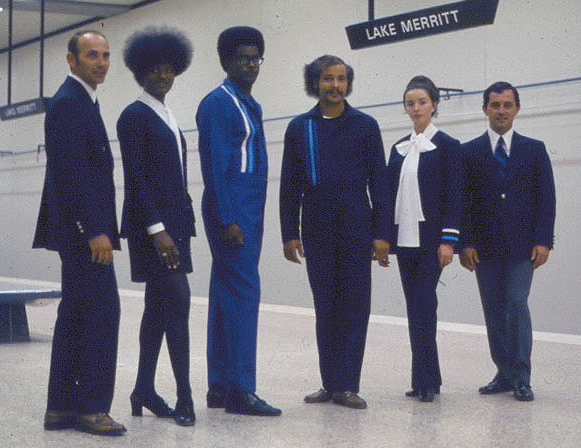
BART employees in the 1970s.
Hundreds of meetings were held in the District communities to encourage local citizen participation in the development of routes and station locations. By midsummer, 1961, the final plan was submitted to the supervisors of the five District counties for approval. San Mateo County Supervisors were cool to the plan. Citing the high costs of a new system-plus adequate existing service from Southern Pacific commuter trains - they voted to withdraw their county from the District in December 1961.
With the District-wide tax base thus weakened by the withdrawal of San Mateo County, Marin County was forced to withdraw in early 1962 because its marginal tax base could not adequately absorb its share of BART's projected cost. Another important factor in Marin's withdrawal was an engineering controversy over the feasibility of carrying trains across the Golden Gate Bridge.
BART had started with a 16-member governing Board of Directors apportioned on county population size: four from Alameda and San Francisco Counties, three from Contra Costa and San Mateo, and two from Marin. When the District was reduced to three counties, the Board was reduced to 11 members: four from San Francisco and Alameda, and three from Contra Costa. Subsequently, in 1965, the District's enabling legislation was changed to apportion the BART Board with four Directors from each county, thus giving Contra Costa its fourth member on a 12-person Board. Two directors from each county, hence forth, were appointed by the County Board of Supervisors. The other two directors were appointed by committees of mayors of each county (with the exception of the City and County of San Francisco, whose sole mayor made these appointments).
The five-county plan was quickly revised to a three-county plan emphasizing rapid transit between San Francisco and the East Bay cities and suburbs of Contra Costa and Alameda counties. The new plan, elaborately detailed and presented as the "BART Composite Report, " was approved by supervisors of the three counties in July 1962, and placed on the ballot for the following November general election.
The plan required approval of 60 percent of the District's voters. It narrowly passed with a 61.2 percent vote District-wide, much to the surprise of many political experts who were confident it would fail. Indeed, one influential executive was reported to have said: "If I'd known the damn thing would have passed, I'd never have supported it. "
The voters approved a $792 million bond issue to finance a 71.5 mile high-speed transit system, consisting of 33 stations serving 17 communities in the three counties. The proposal also included another needed transit project: rebuilding 3.5 miles of the San Francisco Municipal Railway. The new line would link muni streetcar lines directly with BART and Market Street stations, and four new Muni stations would be built.
The additional cost of the transbay tube -- estimated at $133 million -- was to come from bonds issued by the California Toll Bridge Authority and secured by future Bay Area Bridge revenues. The additional cost of rolling stock, estimated at $71 million, was to be funded primarily from bonds issued against future operating revenues. Thus, the total cost of the system, as of 1962, was projected at $996 million. It would be the largest single public works project ever undertaken in the U.S. by the local citizenry.
After the election, engineers immediately started work on the final system designs, only to be halted by a taxpayer's suit filed against the District a month later. The validity of the bond election, and the legality of the District itself, were challenged. While the court ruled in favor of the District on both counts, six months of litigation cost $12 million in construction delays. This would be the first of many delays from litigation and time-consuming negotiations involving 166 separate agreements reached with on-line cities, counties, and other special districts. The democratic processes of building a new transit system would prove to be major cost factors that, however necessary, were not foreseen.
MORE JOBS
-
$86,465.60 - $129,230.40 Annually - 129230 Annually
Equipment Mechanic I/II (Open and Promotional)
- County of San Mateo, California
- County of San Mateo, CA
- Jul 31, 2026

-
$74254.226563
Information Technology Professional (IT Support)
- Albany, California
- U.S. Navy
- Aug 12, 2026

-
$93,062.16 - $113,127.84 Annually
Human Services Social Worker Master's Degree including Special Skills Classes
- Sacramento, California
- Sacramento County, CA
- Apr 24, 2026

-
$109,948.80 - $132,537.60 Annually - 132537 Annually
Behavioral Health Practitioner Bilingual (Spanish & English) Health and Human Services
- San Rafael, California
- MARIN COUNTY, CA
- Jul 03, 2026
-
$93,620.80 Annually
Police Officer Trainee
- Petaluma, California
- CITY OF PETALUMA, CA
- Jun 10, 2026

-
$21.61 - $29.17 Hourly - 29 Hourly
Program Instructor - Challenge Course ($21.61/hour - $29.17/hour)
- Hayward, California
- Hayward Area Recreation and Park District
- Aug 01, 2026