Job Description
SOUTH COAST AQMD AND JOB OVERVIEWABOUT SOUTH COAST AQMD
South Coast Air Quality Management District (South Coast AQMD) is one of the largest and most technologically sophisticated environmental regulatory agencies in the nation, serving a four-county region that includes Los Angeles, Orange County, Riverside and San Bernardino counties, and the Coachella Valley. South Coast AQMD's headquarters is located in Diamond Bar, 30 miles east of downtown Los Angeles, at the junction of the 57 and 60 Freeways. With a highly diverse "Clean Air Team" of over 870 employees, an annual budget of $225.2 million, and a state-of-the art air quality laboratory, our mission is to ensure clean air and a healthy environment. South Coast AQMD is an organization you can be proud to work for -- we make a difference in the quality of life in Southern California!
South Coast AQMD is committed to creating and maintaining a work environment that appreciates the unique backgrounds, skills, and experiences of our employees and fosters professional development and growth. South Coast AQMD respects the ideas and perspectives of our stakeholders and works to bring them together toward the common goal of clean air.
ABOUT OUR LABORATORY
South Coast AQMD's laboratory employs over 40 staff in a 20,000 square foot state-of-the-art facility dedicated to air quality sample analysis. It provides a broad array of services generating actionable data that is used for strategic planning, investigating complaints from the community, evaluating new products and processes, supporting incident responses and determining compliance with regulations. We also provide data to the California Air Resources Board, US EPA, law enforcement agencies, and universities. Results generated by the laboratory have been the catalyst for agency-wide policy decisions, special studies, and technology development. We analyze over 60,000 samples per year using various analytical laboratory techniques; including GC, IC, LC, GC-MS, XRF, XRD, FTIR, microscopic analysis, ICP-MS, and PTR-MS to generate detailed information on the types and amount of pollutants in ambient air. The South Coast AQMD laboratory is at the forefront of method development for ambient air analyses and obtains national recognition in the field of air quality analytical chemistry.
ABOUT THIS POSITION
The South Coast AQMD is seeking qualified candidates to fill a Principal Air Quality Chemist vacancy. From this recruitment process, we expect to establish an eligible list from which current and future vacancies may be filled, during the 6-12-month life of the list.
Principal Chemists are expected to have expertise in many analytical techniques, data analysis, and to supervise the work of staff in their respective group. Therefore, the most competitive candidates for this position will bring a strong combination of education, atmospheric and analytical chemistry training and experience, broad knowledge of QA/QC procedures, and supervisory skills and readiness. This position will be responsible for oversight of the South Coast AQMD laboratory's Advanced Spectrometry and Microscopy groups. The primary role of the Advanced Spectrometry Principal Chemist is to help with community monitoring needs under several South Coast AQMD programs, including AB 617 (Community Air Toxics Monitoring), incident response, rule development and support, and special monitoring projects using a mobile Proton-Transfer-Reaction-Time-of-Flight-Mass Spectrometer (PTR-MS) and other advanced instrumentation.
The Principal Air Quality Chemist is a supervisory position reporting to the Laboratory Manager. This vacant position is one of four Principal positions making up the laboratory supervisory team; each team consists of eight to sixteen chemists, technicians, and support staff. Teams are aligned by function, including compliance analysis, ambient VOC/toxics analysis, aerosol analysis, and advanced spectrometry/microscopy.
EXAMPLE OF DUTIES
The general Example of Duties for this classification are highlighted below, for full description of duties please refer to this link here .
- Plans, organizes, and supervises the work of staff assigned to a laboratory section involved in qualitative and quantitative analyses to isolate, identify, and quantify air contaminants; reviews requests for analyses, determines the level of difficulty, and assigns work; and provides technical and administrative guidance to professional and technical staff and evaluates performance.
- Develops, supervises, prioritizes, and evaluates programs and projects; maintains workload statistics on unit activities; prepares program- and activity-related reports and analyses; reviews and edits technical reports prepared by laboratory staff to ensure accuracy of data, appropriateness of methodologies, and soundness of findings and conclusions; and identifies and maintains data quality objectives on a program basis.
- Serves as a technical expert and resource for South Coast AQMD staff regarding chemistry-related air quality matters and on a variety of technical advisory committees; maintains a broad understanding of current research into causes, sources, and chemical reactions contributing to air quality problems; and consults with outside experts regarding air quality issues relevant to laboratory programs and projects.
- Applies professional training and experience and keeps abreast of updated and new chemical laboratory methods, instrumentation, protocols, and practices through review of professional literature and other research resources and evaluates staff recommendations to ensure the laboratory uses the most effective and up-to-date techniques in analyzing air contaminants, accomplishing the work of the unit, and meeting new or changing South Coast AQMD rules.
- Reviews and approves test methods used by private laboratories for compliance with South Coast AQMD rules.
- Represents South Coast AQMD at scientific conferences and prepares for publication and presents research reports and papers on methods, procedures, results, and conclusions relating to laboratory analyses.
- Testifies in court and before public bodies and hearing boards.
- Prepares annual budget request for the section and submits written justification for budget items requested; and is responsible for the preparation of grant proposals for federal government or other funding.
- Acts for the laboratory services manager, as needed.
MINIMUM AND DESIRABLE QUALIFICATIONS
DESIRABLE QUALIFICATIONS
In addition to the Minimum Qualifications which follow, the most competitive candidates will also possess:
- Experience with the measurement of Volatile Organic Compounds (VOCs) in ambient air, and the analysis, interpretation, and presentation of resultant data sets.
- Experience with mobile measurements and/or field studies using research grade instrumentation, particularly mass spectrometry techniques such as PTR-MS and spectroscopic methods such as CRDS and TILDAS; along with other analytical techniques for the measurement of ambient gases and particles.
- Experience with microscopic analysis for asbestos and other ambient particulate matter using polarized light microscopy, electron microscopy with EDS, XRD, FTIR, and other techniques.
- Knowledge of QA/QC procedures and guidelines to ensure data is accurate and representative of the samples being collected following proper documentation procedures.
- Detailed knowledge of matters directly related to ambient air analysis, laboratory instrumentation and data management.
- Exceptional leadership, oral presentation, and written communication skills.
- Experience overseeing the work of laboratory professionals and support staff.
- Ability to identify and resolve complex programmatic and administrative challenges in a fair, impartial, and professional manner.
- Ability to implement and track the progress of programs and innovative solutions to improve efficiency and productivity.
- Ability to conceptualize mobile monitoring and field data using GIS based visualizations.
- Ability to manage workloads to ensure timely turnaround of sample analysis and data collected during field measurements.
- Ability to lead teams operating field instrumentation, both stationary and mobile, that is used extensively for monitoring pollutants near facilities and in nearby communities as well as for incident response.
- Ability to oversee contracts for monitoring studies along with collaborating with researchers at universities and other agencies.
- Ability to present technical data to various stakeholders having a wide range of scientific and professional backgrounds.
- Strong computer and data review skills for large complex datasets that harmonize data from several instruments often with different time resolutions.
- Flexibility, dependability, and a positive, can-do attitude.
MINIMUM QUALIFICATIONS
EDUCATION: Graduation from an accredited college or university with a bachelor's degree in chemistry, preferably with an emphasis in qualitative and quantitative analysis.
EXPERIENCE:
One (1) year as a Senior Air Quality Chemist or equivalent (One year working as a Manager, Supervisor, Senior Chemist, or similar leadership position that oversees a group of chemists focused on air quality measurements and/or research)
OR
Three (3) years as an Air Quality Chemist or equivalent (Three years working as a Chemist conducting air quality analysis).
KNOWLEDGE OF: Current methods, procedures, protocols, and instrumentation relating to organic, inorganic, and physical qualitative and quantitative analysis; operational principles of relevant chemical laboratory instrumentation and techniques; principles and practices of project management, supervision, training, and budgeting; relevant professional research literature and resources; principles and methods of statistical analysis; working knowledge of database design, information management, and computer programming, as they relate to laboratory analysis of air contaminants; safety procedures and practices relating to laboratory work; PC software applications common to the field and to the general business environment of South Coast AQMD; professional report writing; South Coast AQMD rules and federal and State laws related to chemical analysis of air contaminants; and protocols and standards for laboratory analysis of air quality samples.
SKILL OR ABILITY TO: Supervise, evaluate, train, and assign work to professional and technical staff involved in routine and complex qualitative and quantitative organic, inorganic and physical analysis of air quality samples; effectively use available resources in planning and organizing programs and projects; evaluate the effectiveness of programs and projects in meeting laboratory and overall South Coast AQMD objectives; oversee the development and implementation of new laboratory methods, procedures, and protocols, the adaptation of existing instrumentation and methods for new purposes, and the evaluation of new instrumentation; understand and interpret applicable laws, rules, and regulations; edit and write detailed, accurate reports on laboratory projects, analyses, methodologies, findings, and conclusions; prepare funding proposals; read, understand, and follow verbal and written directions; proficiently use PC software applications common to the field and to the general business environment of South Coast AQMD; communicate clearly and concisely, both orally and in writing; and establish and maintain effective relationships with all those contacted in the course of work.
LICENSE: Possession of a valid California Class "C" Driver's License and a good driving record may be required.
OTHER IMPORTANT INFORMATION
APPLICATION PACKETS MUST INCLUDE
A completed employment application covering at least the past 10 years of employment history (or longer if you have other relevant experience), and your entire South Coast AQMD employment history if you are a South Coast AQMD employee.Responses to the Supplemental Questionnaire (SQ). The SQ is a form of written test and will be evaluated as such. Your responses should be well written, clear, concise, and directly responsive to the question.Up to four references which include the names and phone numbers of your present and past supervisors or managers, and/or college professors or persons for whom you have directly provided services, not peers .An unofficial copy of your transcripts (or equivalency evaluation if your education was obtained outside the U.S.), documenting all qualifying education claimed, submitted as an attachment to your online application* .
*You MUST submit acceptable documentation for all education claimed on your application. Acceptable documentation consists of an unofficial copy of your transcripts/equivalency evaluation attached to your application . At a later date, candidates under final consideration will be required to arrange for original, official transcripts (or equivalency evaluation, if applicable) to be mailed directly from their college/university to South Coast AQMD, documenting all education claimed on their application.
Job applications must be completely filled out. A resume cannot be substituted for the required information. Be sure to detail any education, training or other relevant coursework that would make you a particularly strong candidate.
THE SELECTION PROCESS
Application packets, including responses to the Supplemental Questionnaire, will first be screened, and the most competitively qualified candidates will advance to the next step in the process, which is expected to be a qualifying interview. (Please note that some assessments may be conducted remotely).
Following the assessment process, a ranked eligible list is expected to be created, from which current and future vacancies may be filled, during the 6-12-month life of the list. Only those who demonstrate they are among the most competitively qualified, at each successive step of the selection process, will be advanced to the next step. (Meeting the minimum requirements does not guarantee an invitation to the next step.)
Important note for potential candidates who do not have the continued and unrestricted right to work full time in the United States: If you currently, or will in the future, require sponsorship (i.e., H1-B Visa) in order to maintain your right to work in the United States, you are welcome to participate in this recruitment process, but there is no guarantee that a job offer with the requested sponsorship will be made to you.
South Coast AQMD reserves the right to add, delete, and modify any elements of the selection process as deemed appropriate, based on the number and quality of applicants at each step.
Please call Human Resources at least one week in advance if you might need an accommodation at any step during the selection process. If you have any questions regarding this recruitment, please contact Human Resources Department at (909) 396-2800.
PROFESSIONAL EMPLOYEE BENEFIT OVERVIEW
BENEFIT
DESCRIPTION
Monthly Benefit Allotment
$1,912, to purchase medical, dental, and life insurance, with unused portion paid to you as cash. Your insurance coverage becomes effective on the first of the month following completion of 30 days of continuous service. Dependent children may be covered to age 26 on medical, dental and vision plans.
Medical Health Plans
Blue Shield PPO
Blue Shield PPO Savings Plus 2250 (High Deductible Plan)
Blue Shield HMO
Kaiser HMO
Kaiser HSA HMO 1500 (High Deductible Plan)
Dental Plans
Delta Dental PPO (without orthodontic benefits)
Delta Dental PPO (with orthodontic benefits for children only)
DeltaCare (PMI) Dental
Vision Plan
EyeMed - Optional
Life Insurance
$10,000 Term Life Insurance
(Optional additional life insurance, paid by you, at 1X, 2X, or 3X your salary)
Employee Assistance Program (EAP)
Claremont EAP, powered by Uprise Health. EAP is available to all employees and their familiels at no cost. EAP offers confidential advice, support and practical solutions to real-life issues.
Accidental Death & Dismemberment
Optional
Section 125
Optional Plans (Medical Reimbursement; Dependent Care)
Work Schedule
Four 10-hour days, Tuesday through Friday
Vacation
80 hours per year, increasing to 120 after five years
Holidays
13 paid holidays per year
Sick Leave
100 hours per year
Other Leaves
Bereavement; Jury Duty; Military; Witness
Tuition Reimbursement
Reimbursed up to $5,000 per year
Deferred Compensation (457 Plan)
Optional (Employee may contribute up to the IRS maximum). South Coast AQMD matches, dollar for dollar up to $300 per year for the regular plan.
Retirement
2.5% @ 67 defined benefit plan - Applies to employees hired on or after January 1, 2013 who, at time of hire, were not members of the San Bernardino County Employees' Retirement Association (SBCERA) or another public employee retirement system through which reciprocity may be established.
2.0% @ 55 defined benefit plan - Applies to employees who, prior to January 1, 2013, were active members of SBCERA or another public employee retirement system through which reciprocity may be established.
Employees pay only the Medicare portion of Social Security.
03/01/2024
Closing Date/Time: 9/3/2026 11:59 PM Pacific
South Coast Air Quality Management District
909-396-2800South Coast Air Quality Management District (South Coast AQMD) is one of the largest and most technologically sophisticated environmental regulatory agencies in the nation. We serve a four-county region that includes all of Orange County and the urban portions of Los Angeles, Riverside, and San Bernardino counties, home to more than 17 million people. South Coast AQMD's headquarters is located in Diamond Bar, 30 miles east of downtown Los Angeles, at the junction of the 57 and 60 freeways. With a highly diverse "Clean Air Team" of over 750 employees, an annual budget of $170.9 million, and a state-of-the art air quality laboratory, our mission is to ensure clean air and a healthful environment.
Mission
To clean the air and protect the health of all residents in the South Coast Air District through practical and innovative strategies.
What is the South Coast AQMD?
South Coast AQMD is the regulatory agency responsible for improving air quality for large areas of Los Angeles, Orange, Riverside and San Bernardino counties, including the Coachella Valley. The region is home to more than 17 million people–about half the population of the entire state of California.
Despite significant improvements to air quality, more work needs to be done to protect public health through innovative and practical strategies. Air pollution can cause or worsen many health problems, including asthma attacks, heart disease, certain types of cancers and premature death. South Coast AQMD has been at the forefront of the nation’s air pollution reduction efforts for more than eight decades.
What South Coast AQMD Does
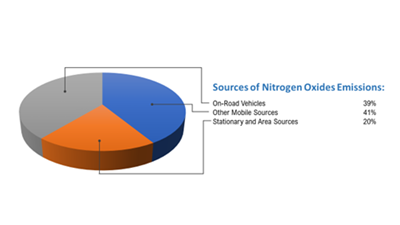
South Coast AQMD is responsible for controlling emissions primarily from stationary sources of air pollution. These can include anything from large power plants and refineries to the corner gas station. There are about 28,400 such businesses operating under South Coast AQMD permits. Many consumer products are also considered stationary sources; these include house paint, furniture varnish, and thousands of products containing solvents that evaporate into the air. About 25% of this area's ozone-forming air pollution comes from stationary sources, both businesses and residences. The other 80% comes from mobile sources–mainly cars, trucks and buses, but also construction equipment, ships, trains and airplanes. Emission standards for mobile sources are established by state or federal agencies, such as the California Air Resources Board and the U.S. Environmental Protection Agency, rather than by local agencies such as the South Coast AQMD.
How South Coast AQMD Controls Pollution
South Coast AQMD develops and adopts an Air Quality Management Plan, which serves as the blueprint to bring this area into compliance with federal and state clean air standards. Rules are adopted to reduce emissions from various sources, including specific types of equipment, industrial processes, paints and solvents, even consumer products. Permits are issued to many businesses and industries to ensure compliance with air quality rules. South Coast AQMD staff conducts periodic inspections to ensure compliance with these requirements.
The test of whether these efforts are working is the quality of the air we breathe. South Coast AQMD continuously monitors air quality at 38 locations throughout the four-county area. This also allows South Coast AQMD to notify the public whenever air quality is unhealthful.
South Coast AQMD’s Sources of Revenue
To meet its financial need, the South Coast AQMD utilizes a system of evaluation fees, annual operating fees, emission fees, Hearing Board fees, penalties/ settlements and investments that generate approximately 73% of South Coast AQMD’s revenue. The remaining 27% of its revenue is from federal grants, California Air Resources (CARB) subvention funds, and California Clean Air Act Motor Vehicle fees.
Progress So Far
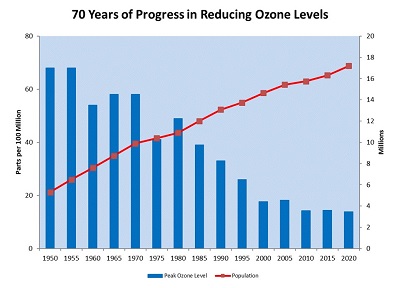
Air quality in this area has continually improved despite an enormous increase in population and cars. For example, maximum levels of ozone, one of our worst smog problems, have been cut to less than one quarter of what they were in the 1950s, even though today we have nearly three times as many people and four times as many vehicles.
In recent decades, we have eliminated Stage I smog alerts, which used to occur 100-120 times a year. We have not reached Stage II levels since the 1980s.
The Job Ahead
The clean air effort still has a long way to go. In 2005, the federal 1-hour standard was replaced by a stricter 8-hours standard that was further strengthened in 2008. Even though recent years have been the cleanest on record, our air in the South Coast Air Basin still exceeded the federal health 8-hour standard for ozone on 113 days in 2009. Maximum levels are almost twice as high as the federal standard for clean air.
State and federal law requires this area to meet existing clean air standards by the year 2015 for annual PM 2.5; and by 2023 for the 8-hour average ozone standard. However, tougher federal air quality standards for particulates and ozone issued in 2006 and 2008 require reductions above and beyond those already planned. South Coast AQMD estimates it will take until at least 2020 to meet the new 24-hour average particulate standard, and until 2030 to meet the new ozone standard. This may seem like a long time to continue to live with smog. But the cleanup effort is enormous. Even though we already have the strictest pollution control requirements in the nation, we still have to reduce some types of pollution by up to 90% if we are to rid the area of smog.
The war on smog began in this region more than a half century ago. With continued commitment and sensitivity to the impacts of efforts to control smog, residents can be assured that public health standards for air quality will be achieved.
MORE JOBS
-
$229,553.04 - $337,476.04 Annually - 337476 Annually
County Chief Financial Officer
- Ventura, California
- County of Ventura
- Sep 29, 2026

-
$158,650.17 - $222,132.02 Annually - 222132 Annually
Deputy Executive Officer - Budget and Finance
- Ventura, California
- County of Ventura
- Sep 26, 2026
-
Depends on Qualifications
Ultrasound Technologist/ Ultrasound Technologist Trainee*
- Colton, California
- SAN BERNARDINO COUNTY, CA
- Oct 05, 2026

-
$93,329.60 - $131,664.00 Annually
Supervising Environmental Health Specialist
- San Bernardino, California
- SAN BERNARDINO COUNTY, CA
- Oct 05, 2026
-
Temporary Faculty Pool, Public Health & Health Science
- Carson, California
- Cal State University (CSU) Dominguez Hills
- Oct 04, 2026

-
Lecturer Pool- Social Sciences AY 2026/27
- San Marcos, California
- Cal State University (CSU) San Marcos
- Oct 04, 2026